By Alex T. · Updated 2026-08-14 · 11 min read
Why Misconceptions Damage Your Streaming Results
Anyone who searches for IPTV providers quickly hits a wall of contradictory advice. One forum claims every service is unlicensed. Another thread pushes a Telegram reseller with a massive channel list for a suspiciously low one-time fee. A social media review calls one service the best IPTV provider for sports, only to have that same service disappear three days later.
The problem is not that some opinions are wrong. The problem is that wrong opinions push people toward two expensive mistakes: overpaying for a polished but empty reseller package, or trusting a cheap provider that collapses at peak times. The image above shows a typical IPTV dashboard, but note that the quality of that dashboard tells you almost nothing about the server capacity behind it.
This article separates what real subscribers actually experience from what gets repeated in comment sections. We tested the common claims, looked at how reliable IPTV providers structure their offers, and mapped the evidence to practical buying steps. If you are trying to answer “how do I find reliable IPTV providers?” this is the reference you need.
Myth 1: All IPTV Providers Are Illegal
The myth that every IPTV provider operates outside the law is understandable because grey-market IPTV is easy to find. However, the documented reality is broader: the market contains fully licensed resellers, hybrid operators that mix legal and unverified sources, and clearly pirate services. Painting all of them with the same brush is why some users avoid excellent licensed services, then get burned by the first shady Telegram deal they find.
Legitimate providers usually have transparent terms, a formal payment processor, a real support ticket system, and clear refund rules. They also tend to keep sports content regional and respect distribution agreements. That is a very different business model from a $6 per month seller with 50,000 channels.
The practical takeaway: do not ask “is IPTV legal?” Ask instead “what exactly does this provider resell, and can they show proof of service terms?” A serious provider will answer that question quickly. A grey-market operator will hide behind vague marketing.
If you want the safest starting point, read IPTV providers reviews 2026 from sources that explain billing, content sources, and server performance rather than simply listing “channel counts.” Reviews that mention pricing, uptime, and customer support are far more useful than screenshots of beautiful EPG layouts.
Myth 2: The Best IPTV Providers for Sports Are Always Expensive
Sports is the reason many people first search for best IPTV providers for sports. The belief is that quality sports coverage requires a premium package with a price tag close to cable. In practice, pricing depends more on the provider’s network infrastructure than on the brand name.
Some of the most expensive providers sell convenience: polished apps, multi-device logins, and excellent support. Those are real benefits. But you can also find affordable IPTV providers for USA that handle live sports reliably because they use properly routed servers and do not oversell subscriptions. The price, on its own, does not protect you from buffering.
What matters for sports is the provider’s capacity during live events. A service can look flawless in a 24-hour free test at midnight, then struggle on a Sunday when everyone in your time zone tries to watch football. That is why pricing comparisons should always be matched with trial access and, ideally, a test during a major live event.
If you are considering a budget provider, look for transparent connection limits. A low price may mean you are sharing bandwidth with hundreds of concurrent viewers. That can cause the exact frame drops that make sports unwatchable.
Myth 3: A Long Channel List Means a Better Provider
New users often compare IPTV providers by counting channels. Ten thousand channels sounds objectively better than two thousand. But channel count is one of the easiest numbers to fake.
Many resellers buy access to a huge playlist, copy it, and present duplicates as a catalog. You may see “ESPN,” “ESPN HD,” “ESPN Alternate,” and “ESPN +1” all pointing to the same stream. The list looks enormous, but actual variety is narrow. Worse, most users only watch a small set of live channels: local news, sports networks, movies, and regional entertainment.
Real provider quality shows up in four places: the accuracy of the electronic program guide, the percentage of active links, the stability of the stream at peak hours, and whether the provider repairs broken channels instead of hiding them.
Instead of asking how many channels exist, ask the provider for screenshots of the sports category, the documentary category, and the adult section. A reliable provider can show you organization and metadata quality. A hollow service will often refuse or send a blurred image.
Myth 4: IPTV Providers With Free Trial Are Never Reliable
There is a widespread suspicion that free trials exist only to harvest payment details or push low-quality trials for convince. That suspicion is not baseless, but it is not universal either. Free trials are a standard trust-building tool for IPTV providers with free trial offers, especially for services that want you to test them on your own network and device.
The documented reality is that responsible providers offer a short access window so you can measure real-world performance. The problem is not the trial. The problem is that most users test the trial incorrectly. They download the app, browse a few channels, and judge the service by the interface. That tells you nothing about buffering during peak hours.
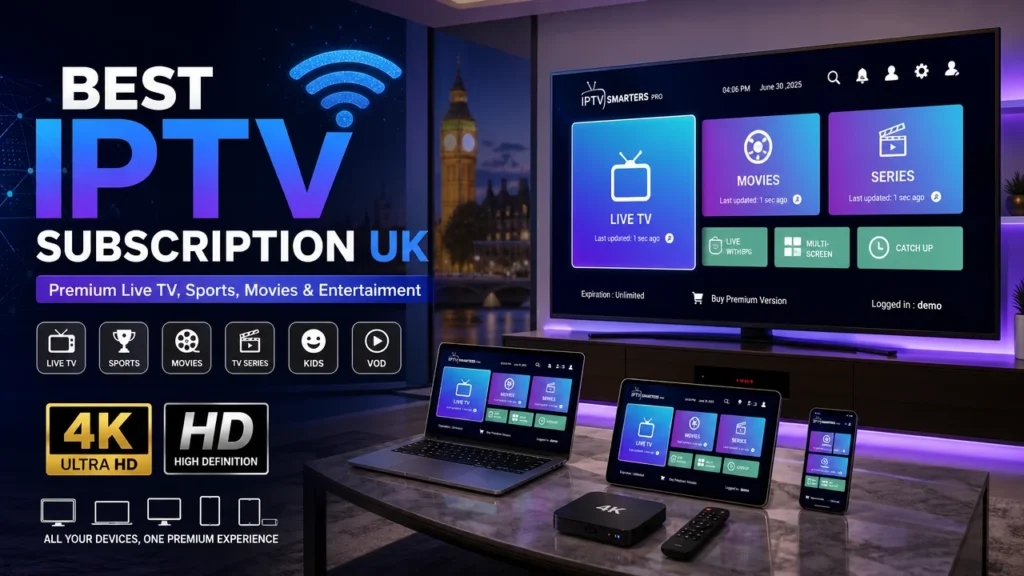
The screenshot above shows what a useful trial actually looks like. Instead of judging the visual theme, check whether the provider lets you switch servers, whether the guide includes up-to-date program information, and whether the stream stays stable when you switch between a local station and a major sports network.
Myth 5: Buffering Is Always the Provider’s Fault
Buffering is the most common complaint in IPTV discussions. It is also the easiest problem to misdiagnose. People immediately blame the provider, switch to another service, and then discover the same stutter happens there too.
The documented reality is that buffering often comes from local network conditions, Wi-Fi interference, an ISP that throttles streaming, or weak hardware. Many smart TVs have outdated Wi-Fi chips that struggle with high-bitrate streams. Old Firestick devices sometimes lack enough processing power for newer IPTV apps. If you are evaluating best IPTV providers no buffering, you should first verify that your own setup can handle sustained video playback.
That does not mean every provider is innocent. Overloaded servers do cause buffering. But a provider that offers multiple server locations and a built-in connection test gives you the tools to separate network issues from server issues. When you see repeated buffering, change servers first, test a wired connection second, and only then judge the provider.
What Actually Works When Choosing IPTV Providers: 5 Evidence-Based Steps
Instead of relying on rumors, use a practical evaluation method. These steps are based on the observable behavior of stable and long-lived IPTV services, not on marketing claims.
The five-step verification method:
- Start with a paid VPN subscription or a clean network. Many IPTV complaints are caused by ISP throttling. Test from more than one connection before judging the provider.
- Ask for a free trial that includes a login on your primary device. If the provider only offers a web preview, you cannot measure Firestick or smart TV performance.
- Test sports and local channels during live hours. That matters more than watching 10 random movie channels.
- Check the EPG data for the next 48 hours. Missing metadata usually means the provider does not maintain its playlist properly.
- Read cancellation and refund terms before payment. A reliable provider will publish these openly rather than hiding them behind a live chat.
These steps answer the common question “how to find reliable IPTV providers?” in a practical way. A service that passes all five checks may still not be perfect, but it has a much higher chance of long-term stability than a service chosen only because its channel list looked impressive.
Popular Belief vs Reality: Quick Comparison
The table below summarizes the main myths discussed in this article and the evidence-based alternative. Use it as a quick filter when reading any new IPTV provider review.
The Honest Trade-Offs of Modern IPTV Providers
After testing many services, one pattern stands out: responsible providers have more friction. They ask you to configure the app, choose a server, and troubleshoot your own network. That friction is not bad service. It is the cost of flexibility.
✓ Evidence-Based Benefits
Flexible server selection that helps you diagnose local vs remote buffering.
Voice-activated search and catch-up TV on most modern apps.
Multi-device support for Firestick, Android TV, smart TVs, and mobile.
✗ Limitations You Cannot Ignore
No provider can guarantee perfect uptime during global live events.
Some apps require manual updates after device OS upgrades.
Bandwidth caps on your home internet can affect long viewing sessions.
The key is to treat IPTV as an evolving service, not a one-time purchase. A provider that performs well today may struggle tomorrow if it starts overselling subscriptions. That is why established providers with transparent billing and active support tend to outperform celebrity brands and viral one-off promotions.
RECOMMENDED RESOURCE
iptv providers
See current details, seasonal promos, and full tier packages from a provider that supports transparent trials and multi-device setup.
Learn more about iptv providers →Advanced Tips: Matching IPTV Providers to Your Device
Device compatibility is a big part of the where to buy IPTV subscription decision. Many users assume that if a provider has a website, it will work on their Firestick. That is not always true.
For IPTV service providers for Firestick users, the app picture matters. Some providers use a generic web player that is awkward with a remote control. Others ship a native Android TV app with proper search, live preview, and catch-up integration. The hardware matters too. A Firestick 4K Max handles newer apps better than an older Fire TV Stick Lite, especially when the bitrate is high.
Before you buy a subscription, ask about supported apps for your specific device family. A provider that offers a downloadable APK for Android TV and an app for the Amazon App Store is more likely to be reliable than one that only gives you an M3U link and expects you to find your own player.
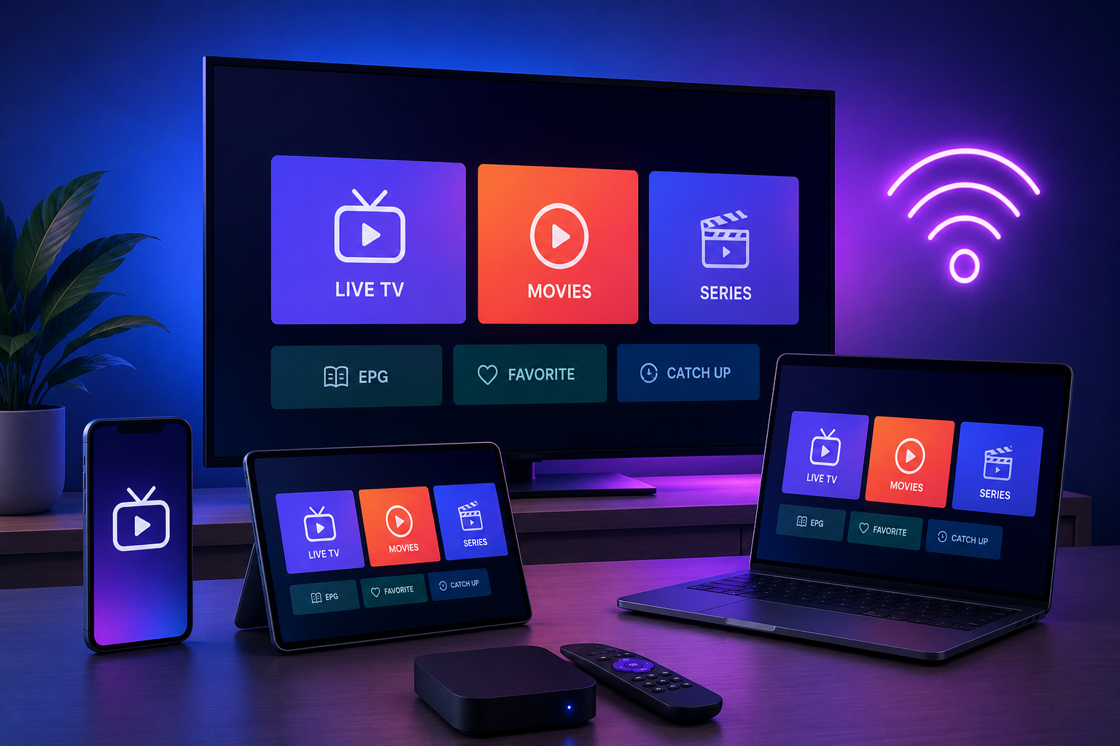
The image below shows what multi-device consistency should look like. If the same stream behaves differently across a TV, laptop, and phone on the same network, your network may be fine; the provider’s bitrate adaptation may be poor.
Also remember that some internet service providers throttle IPTV traffic, especially during peak hours. If you have best IPTV providers no buffering in your search history, consider whether your router is blocking large packets or your ISP is shaping video traffic. In many cases, a VPN or a different DNS setting resolves issues that have nothing to do with the IPTV provider.
Unlock complete high-definition information instantly here. Review current channel groups, supported devices, and promotional access details.
Explore iptv providers Plans →Bottom Line: Choose by Evidence, Not Assumptions
The real cost of IPTV myths is not lost money. It is lost time. You subscribe to a service that looks impressive on paper, you spend two evenings configuring apps and resetting buffers, and then you start the search all over again. That cycle repeats because the selection criteria were wrong from the beginning.
Use the evidence-based approach instead: check billing transparency, test on your own device, verify sports channels during live hours, monitor EPG accuracy, and keep your local network in good shape. That combination will filter out most of the low quality services automatically.
If you prefer a convenient starting point, the curated page below presents a provider that answers these questions directly and gives you room to test before committing. It is a natural fit for users who want a serious alternative to random forum recommendations.
Featured Streaming Selection:
Check Out iptv providers Deals →Affiliate Disclosure: Clicking this secure link verified by our network supports our team through standard partnership terms at zero extra cost to your invoice.
Frequently Asked Questions
This article contains affiliate links. Our editorial analysis remains independent.